

Cure
By Arbogast

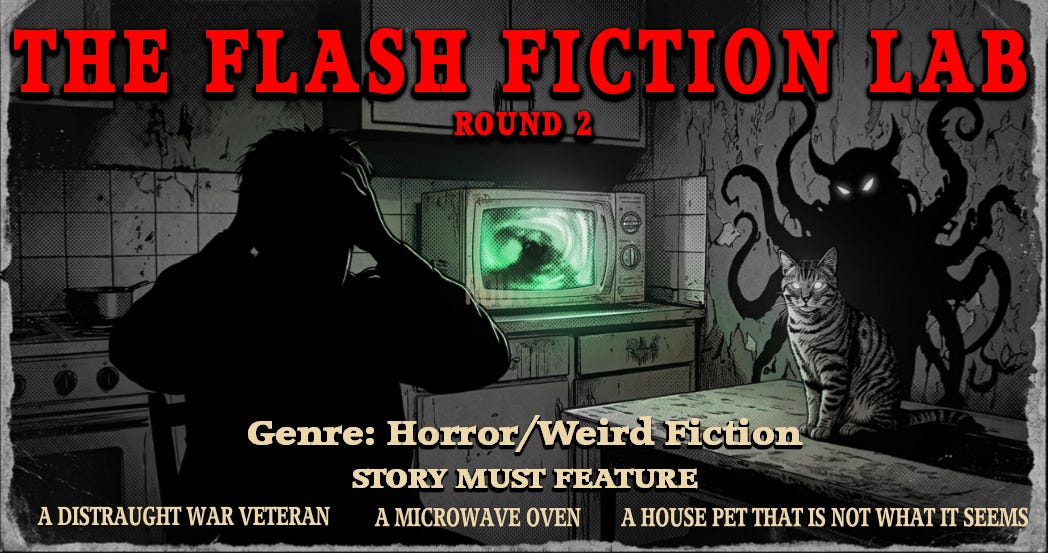
Who better to open this horror/weird fiction onslaught than Arbogast, the man behind 1325 Publishing?
A Ukrainian war veteran is trying to hang onto the last shreds of his sanity, but his doctor may not be on his side—or even of this world…
The dream came again.
The whine of incoming artillery rounds, the whiz of close bullets, and the screams of friends and enemies alike made Melnyk toss and turn for hours until he woke up screaming.
In his nightmare, the last thing he’d seen was Hryniv’s dead face after it had been half-eaten by trench rats as big as a human leg. They had been oh so hungry. Worse still had been the betrayal. His unit had adopted those damned rodents as mascots. They had reciprocated by eating the Ukrainian dead.
Melnyk looked at the clock. It was just a hair after three in the morning. He checked his pulse. It was rapid. He went into the small, slightly dirty bathroom and hovered over the toilet. The night before, he had dry heaved, which he found way worse than vomiting. Fortunately, Melnyk did not puke or dry heave. He just hung loose over the toilet and cried a little. It was a pathetic display, especially for a soldier with a case full of ribbons and medals.
Outside of his windows, the small, quaint city of Kamianka-Buzka slept undisturbed. Here, the war in the east seemed distant. Sure, the people cared and kept the flag flying in window sills and in office spaces, but nobody feared Russian planes or drones or bombs carrying death in every piece of reinforced steel. Melnyk kept it bottled up inside—his night terrors, his moments of panic, and his constant feeling of dread—so as to not disrupt the precious harmony of Kamianka-Buzka. He did not want to be a freak spreading doom and gloom everywhere.
He didn’t want peaceful Lviv Oblast to become like Donetsk or that sea of crushed concrete and glass called Chasiv Yar.
Melnyk waited until five a.m. to text his doctor. It was outrageously early, yes, but Dr. Grabinski replied as if he had been up all night. A ghoul like that probably slept during the day, Melnyk thought.
Several hours later, after catching multiple buses and trains, Melnyk was in the city of Lviv and safely ensconced in Dr. Grabinski’s office. The practice was on the second floor of a bank, and besides some lawyer who never seemed to be in, Dr. Grabinski had the whole floor to himself.
Before saying anything, even before greeting his one and only patient, Dr. Grabinski made sure to microwave his cold cup of tea. The Soviet-era machine whirred and turned, then dinged loudly, making Melnyk a little uncomfortable.
“I don’t know why, but microwaved tea just tastes better,” the strange doctor said. “I guess I like the nuclear acidity on my tongue.”
Grabinski laughed at his own joke. He was the definition of a weird man. He was tall, lithe, and pale with a goatee that had been dyed an obsidian black. He looked like he could be anywhere from forty to eighty, and his Ukrainian was old-fashioned and shot through with several words borrowed from Polish. All Melnyk knew was that the doctor came from an old noble family with roots in the Commonwealth era, and that his experimental techniques had supposedly helped several of his old comrades to overcome Deactivation Syndrome.
“Was it the same nightmare?” the doctor asked.
“Yes. It was the same one as always.”
“Sorry to hear that. However, be of good cheer. The shipment came in today.”
Melnyk sat up in his seat. For months, Dr. Grabinski had been talking about some cutting-edge laboratory in the United States. Kingsport, Massachusetts, to be exact. Grabinski claimed that the place made mood-altering chemicals that worked faster than SSRIs or street suppressants.
He handed Melnyk two boxes. His thin, skeletal fingers tapped one, and then the other.
“This box contains greetings from the United States. It’s a month’s worth of chemicals in glass vials. Handle this package with care. The same goes for the other one, which is a personal treat from me.”
Melnyk watched the other box closely. It moved a little.
“What’s in that one?”
“A therapy animal.”
“A cat? A dog?”
“Yes, something like that.”
Melnyk didn’t like that answer. Dr. Grabinski saw this and held up a pair of comforting hands.
“It’s for your health, Sasha. Pets promote wellbeing and peaceful sleep. Don’t you want to get rid of the nightmares?”
Melnyk nodded yes. He did want to get rid of the nightmares.
Hours later, Melnyk was back in his apartment. He ripped open the package of vials. He removed one and studied the liquid’s color. It was turquoise but not quite. There were flecks of brown in the substance, and it glowed a little. Normally, Melnyk would have discarded any unknown substance down the drain, but this time he was desperate. He removed the cork and sniffed. To his surprise, there was no smell at all.
He leaned back in his bed and poured the contents down his throat. His muscles relaxed in an instant, and his eyelids became heavy. His arms and legs became slow until they became unmovable. Every part of the old soldier fell into total slumber except for his mind.
It was still active. It was still aware.
Melnyk recognized the sensation as sleep paralysis, yet it occurred while he was wide awake.
The other package moved again. Subtle at first, and then more violently.
The animal. It was the animal breaking free.
Melnyk watched as the unknown creature bit its way through the flimsy cardboard. He heard it bust through its prison, and he felt it climb up his frozen feet. In the darkness of his bedroom, all Melnyk could tell was that it had dark-colored fur and was as big as a cat. And yet it squeaked like a mouse, and its paws felt like human hands.
Melnyk only saw the horrid truth when the animal perched itself on his nose.
It was a blind rat with rat teeth and a human face. It said words in English to Melnyk before starting the long, slow process of consuming his sweating face.
Rats & veterans do seem to go together. The dream imagery here is very powerful.
Great adaptation of the constraints- the "sleep paralysis demon rat" was genuinely scary. Called to my mind that painting by Fusili, "The Nightmare."